
Specifying a green wall is rarely as simple as choosing between living and artificial on appearance alone. The right answer depends on the building, the brief, the budget and a handful of technical factors that don’t always surface until well into a project, sometimes after a system has already been installed and started to cause problems. The six questions below are the ones we’d encourage any architect or specifier to work through before committing, in roughly the order we’d suggest asking them.
Fire performance is the question that should come first when specifying an artificial green wall, because it’s the one with the least room for compromise. It’s also more complicated than it first appears, particularly for living systems.
Many living walls do carry good fire ratings, and that’s a genuine achievement given the material involved. The complication is that those ratings are typically tested and certified under moist, healthy growing conditions. A peer reviewed study on the fire safety risks of external living walls concluded that maintenance of living walls should not be treated as a desirable option but as a necessity for fire safety compliance, since the tested fire performance only holds while plant health and moisture levels match the conditions under which the system was originally certified. If irrigation fails, or maintenance lapses, the picture changes quickly. Dry, dead vegetation is significantly more combustible than the living material the system was tested with, and at that point a wall that was specified partly on the strength of its fire rating can become a genuine liability rather than an asset.
This isn’t a hypothetical concern. One of the UK’s earliest high profile living walls, installed on a children’s centre in Islington in 2006, died within three years when its irrigation system failed, leaving a large area of dead, dried foliage in its place. Multiply that scenario across a building where nobody has caught the failure early, and the fire safety implications become obvious.
Vistafolia’s artificial systems remove that variable entirely. Our foliage is independently tested and classified to EN 13501-1:2018 and ASTM E84, with fire retardant properties compounded into the material during manufacture rather than applied as a surface coating. That classification doesn’t depend on ongoing irrigation, plant health or anyone remembering to schedule a maintenance visit. It’s the same on day one as it is five years later.
This is one of the most useful questions to ask before specifying a green wall, and it’s worth asking honestly and early, because it changes the answer to almost everything that follows.
If a client’s genuine objective when specifying a green wall is biodiversity, habitat creation or measurable ecological value, an artificial system cannot deliver that and shouldn’t be presented as though it can. That’s a living wall’s territory, and no amount of realistic foliage changes the fact that an artificial system supports no insect life, no pollination and no genuine ecosystem function.
But a great deal of green wall specification isn’t actually about biodiversity at all. It’s about creating an attractive, natural looking feature, whether that’s softening a reception area, breaking up a facade, or giving a courtyard some visual life. Where that’s the real objective, an artificial system becomes a serious option worth weighing carefully, because it delivers the same visual and psychological benefit associated with greenery, without the long term maintenance commitment, without the risk of dying, and often at a fraction of the ongoing cost. Establishing which of these two categories a project actually falls into, rather than assuming, is one of the more useful conversations to have with a client before specifying anything.
The physical realities of a location rule out more options than most people expect at the outset, which is exactly why suitability deserves its own question when specifying a green wall rather than being assumed.
Living walls need regular, hands on maintenance, which means whoever’s doing that work needs to be able to reach every part of the wall safely and reasonably often. A living wall at height, on a roof terrace, or in another position with awkward or infrequent access can become genuinely difficult to maintain properly, and a living system that can’t be properly maintained is exactly the scenario the fire safety question above is warning against. Exposure matters too. Wind loading on an elevated or exposed facade can stress irrigation systems and root structures in ways that are hard to predict from ground level plans.
Artificial systems sidestep the access and exposure problem, but suitability still matters within that category. Not every artificial system is built to the same standard, and lower quality products can fade, discolour or degrade noticeably within a couple of years outdoors, particularly on south facing or heavily exposed elevations. That’s where the choice of supplier becomes as important as the choice of system, and it’s a large part of why Vistafolia’s UV stabilisation is compounded into the material itself rather than sprayed on afterwards, so the performance doesn’t wear off the way a surface treatment would.
Following on from suitability, it’s worth asking this question directly of any artificial system being considered when specifying a green wall, because the honest answer varies enormously between suppliers and rarely gets asked until after installation, by which point it’s too late to change course.
Cheap artificial foliage is often made without genuine UV stabilisation, or with a UV coating applied to the surface rather than built into the material. Coatings wear off with weather, handling and time, and once they do, the underlying plastic is left exposed and begins to fade, chalk or become brittle, usually faster than anyone specifying it expected. A wall that looked convincing in the showroom or on installation day can look tired and obviously artificial within two or three years, which is the opposite of what anyone specifying a green wall is trying to achieve.
Vistafolia’s artificial green wall panels are backed by a five year warranty and independently tested for UV stability, with that resistance built into the material during manufacture. For an architect specifying a green wall on behalf of a client, being able to point to genuine testing and a meaningful warranty period, rather than a vague durability claim, is a reasonable thing to expect and to ask for.
Almost every supplier in this market will describe their product as premium, realistic and long lasting. Those words cost nothing to use and very little to verify at a glance, which makes it worth asking any supplier to substantiate their claims rather than simply repeating them before specifying a green wall on their word alone.
Independent fire and UV test certificates, a warranty with clearly stated terms, and a portfolio of real, verifiable projects are the kind of evidence that separates a genuinely credible supplier from a confidently worded one, and asking for them is a reasonable, expected part of specifying a green wall rather than an awkward request. Vistafolia’s systems carry independent fire performance and UV stability testing, a five year warranty, and a track record across major commercial and educational projects that can be reviewed rather than taken on trust. When specifying a green wall for a client who is ultimately putting their name and budget behind the decision, that kind of documented evidence matters considerably more than a persuasive product description.
The final question is often the one that determines whether a project actually goes ahead, and it’s frequently asked too late in the process to be useful. Building it into the conversation early, alongside the other five questions here, tends to produce a much more defensible specification than treating cost as a separate, later negotiation.
Comparing a living and artificial system purely on installation cost misses most of the financial picture. A living wall’s ongoing costs, covering irrigation servicing, feeding, pruning, pest management and plant replacement, accumulate over the years that follow, often substantially. Using a whole-life costing approach in line with ISO 15686-5, our own analysis has found that a living wall can end up costing considerably more than an equivalent artificial installation once maintenance is factored in over a ten year period, even though the artificial system may appear to have a higher upfront cost in isolation. Specifying a green wall on the basis of capital cost alone, without projecting that comparison forward, risks setting a client up for a budget conversation nobody wants to have a few years into ownership.
Working through these six questions tends to make the case for artificial systems clear in a meaningful proportion of commercial and educational projects, and Vistafolia has built its reputation on being able to answer every one of them with genuine evidence rather than a sales pitch whenever a client is specifying a green wall for their site. Our foliage is hand-designed in the UK by an award winning horticulturist and hand assembled at our factories, independently tested for fire performance and UV stability, backed by a five year warranty, and has been specified on a substantial portfolio of commercial, educational and hospitality projects.
If you’re working through a specification and want a second opinion on any of the questions above, get in touch with our team. We’re happy to share test certificates, project references and whole-life cost comparisons for your specific brief, so the decision is based on evidence rather than assumption.
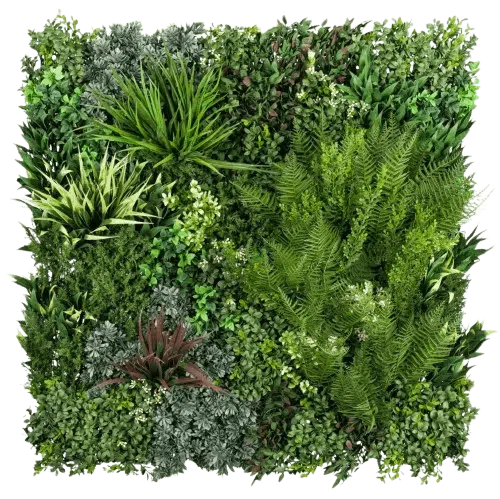 Signature Panel
Our most popular panel with an always-lush look - the ultimate natural backdrop.
Best for: feature walls, living areas, reception spaces
 Essence Panel
A simpler premium-quality mixed foliage panel inspired by our Signature Panels
Best for: fences, gardens, and narrower spaces
 Luxury Flowering Panel
Lush green with a subtle, uplifting bloom-warmth & sophistication.
Best for: terrace & balcony accents, entryways, soft focal points, seating backdrops
 Luxury Boxwood Panel
Perfectly uniform, refined greenery - polished, hedge- like finish.
Best for: formal backdrops, brand walls, privacy screens

Green Walls for Cruise Ships: Lush Greenery at Sea, Without the Maintenance Burden

Artificial Green Wall Specification Guide

How Artificial Green Walls Are Made: Behind the Scenes at Vistafolia
 English (UK) English (UK)
 English (United States)
 French