
Airports are not built to be calm. They are loud, bright, hard-surfaced places designed to move large numbers of people through a series of checks, queues and gates as efficiently as possible, and the materials that make that work, polished floors, glass, steel and strip lighting, are not the ones that make anyone feel relaxed. For a traveller who is already thinking about their gate, their luggage and the clock, the building can add to the pressure rather than take any of it away.
That is changing. Airports are now run as businesses, with passenger satisfaction measured, compared and taken seriously, and more of them are asking what they can do to make a terminal feel more welcoming and a little less sterile. Greenery is one of the most effective answers, and green walls for airports are increasingly the practical way to deliver it. Vistafolia has installed green walls at airports including Heathrow, Brussels, Narita in Tokyo and Nairobi, and at Heathrow alone we have worked in three different terminals, including the Terminal 5 VIP entrance.
Modern airports compete with each other for passengers, airlines and the spending that happens between check-in and boarding. Retail, food and drink are a significant part of how many airports make their money, and a passenger who feels relaxed and comfortable is more likely to spend time in those spaces than one who is anxious and watching the departure board. That is why terminal design has moved from a purely functional exercise to something airports actively use to stand out.
The clearest example is Singapore. Jewel Changi Airport was conceived as a way to widen the gap between Changi and its international rivals, and it is built around a forest valley and a 40 metre indoor waterfall. Changi has become a byword for what an airport can feel like when nature is treated as part of the experience rather than an afterthought. Many other airports have taken note, and the idea that a terminal should feel more like a place than a processing facility is now mainstream, and green walls for airports have become one of the more practical ways to act on it.
Airports are stressful environments, and there is a growing body of work looking at whether greenery can help. A 2025 study published in the journal Buildings surveyed passengers at Terminal 3 of Jakarta’s Soekarno-Hatta Airport. It found that 88 per cent of respondents agreed that seeing plants reduces stress, and that passengers who had not seen any plants in the terminal were 4.57 times more likely to report high stress.
It is worth being clear about what that does and doesn’t tell us. It is a questionnaire based study of one terminal, so it shows an association rather than proving cause, and it should be read as support for the value of visible greenery in terminals generally rather than as a comparison of living and artificial planting.
The researchers also found that very few passengers recalled seeing plants in security and immigration, the most stressful parts of the journey, which suggests the opportunity is as much about where greenery goes as how much of it there is. For airports looking to improve how passengers feel, that is a useful pointer, and one reason green walls for airports are so often specified in entrance areas, lounges and queuing zones.
It is easy to look at Singapore and conclude that every airport should grow its own rainforest. The reality is more nuanced. Living planting on that scale needs a great deal of light, a carefully controlled climate and a dedicated team. When the Forest Valley opened, about 30 gardeners were involved in its upkeep, with plants checked weekly, weeded fortnightly and pruned monthly, and the building itself was designed with a glass facade to give the plants the sunlight they need. That is a remarkable achievement, and it is the right answer for Singapore.
Most terminals are in a very different position. Live plants may not suit every space, every budget or every airport’s maintenance capability, particularly in areas where there is no natural light, where the air is heavily treated, or where bringing contractors in to look after a wall is a significant logistical exercise in its own right. This is where green walls for airports in artificial form come in. They bring much of the same visual warmth into the places where a living installation would be impractical, without needing daylight, irrigation or a gardening team.
Airports are among the busiest public buildings anywhere, and anything installed in them has to cope with constant use and constant scrutiny. A feature that looks tired after a year is a problem in a space seen by thousands of passengers every day, which is why green walls for airports have to be built to a higher standard than most.
Maintenance is a particular consideration. In secure and airside areas, every contractor visit typically has to be planned, escorted and approved, which makes a feature that needs regular horticultural attention far more disruptive than it would be in an ordinary building. Vistafolia panels need no watering, no pruning and no chemicals, and can simply be hosed down or wiped to keep them clean. As our Nairobi Airport case study puts it, a real wall would have been far more complex to install and a logistical nightmare to maintain, while the artificial panels need an absolute minimum of upkeep.
Airports also have an environment of their own. The air around a large airport carries fumes from aircraft and ground vehicles, and the surfaces inside and outside the terminal face a steady deposit of dust and grime. That is a tough setting for anything that has to look good, and living planting would likely struggle in it.
This was one of the key requirements at the Terminal 5 VIP entrance at Heathrow. The entrance needed something to offset a dull grey facade and give VIP clients something attractive to look at, and the solution had to be robust enough to cope with the fume-filled microclimate of a major airport. It also had to resist fading in the sunlight, which is where Vistafolia’s strict UV testing and five year warranty gave the airport’s decision makers the reassurance they needed. The three-panel system was designed to blend seamlessly at the panel edges, and extra planting was added to create the natural randomness of a real wall, because the airport did not want visitors to know the wall was artificial. Once installed it needs nothing more than an occasional hose down to stay looking its best. That combination of realism, robustness and low upkeep is exactly what green walls for airports need to deliver.
Airports have some of the strictest requirements of any commercial setting, covering fire performance, materials, security and more, and they are right to. Requirements also vary from airport to airport and from one area of an airport to another, so we always want to understand them at the very start of a project rather than assume. That applies to every product, and it applies to green walls for airports as much as anything else.
What we can say is that Vistafolia has delivered projects at major airports in the UK, Europe and Africa, and that every system is independently tested for fire performance and UV stability and backed by a five year warranty. For an airport team, documented evidence of that kind is where the conversation starts. If you are considering green walls for airports, share your specific requirements with us early, and we will tell you plainly how the product measures up against them.
An airport is a branded environment, and green walls for airports can do more than soften a space. They can carry a message. Vistafolia walls can incorporate logos, lettering and signage directly into the greenery, and the same approach can be used to support wayfinding, so that a feature wall both welcomes passengers and helps them find where they are going. Our guide to green walls with signage shows how a lush planted backdrop makes a logo or neon sign stand out.
This works especially well for lounges, hotels and premium entrances, where the brand experience matters as much as the practical function. At the Brussels Airlines Sunrise Lounge in Belgium, Vistafolia created a vertical garden for a lounge used by international business travellers, a good example of green walls for airports serving the premium end of the market. At the Four Points by Sheraton at Nairobi International Airport, the client opted for a montage of wood and greenery on a double-height feature wall, creating a unique look that reflects the brand.
Green walls for airports can be used in almost any part of a terminal or airport campus. Entrances and VIP arrival areas make a strong first impression. Lounges and premium spaces benefit from the calm, upmarket feel that greenery brings. Airport hotels, check-in halls, retail and dining areas, family zones and staff spaces can all be softened in the same way, and so can the wider transport hubs around an airport, including station concourses and forecourts.
Whatever the location, green walls for airports are best planned early, alongside the architects and facilities teams. Because the system needs no light and no water, it can go in places where living planting would never survive, and because it can be fitted quickly without irrigation, it causes less disruption in a space that cannot easily be closed.
Vistafolia panels are hand-designed in the UK by an award winning horticulturist and hand assembled at our factories, with around 65 to 72 individual plants in each panel so that the finished wall avoids the flat, repetitive look that gives lower quality products away, which matters when passengers are never more than a few metres from it. Every system is independently tested for fire performance and UV stability and backed by a five year warranty, and our portfolio includes work at Heathrow, Brussels and Nairobi airports.
If you are planning a terminal, lounge, hotel or transport hub project and want to explore green walls for airports, get in touch with our team. We can talk through your requirements, share relevant project examples, and help you decide whether Vistafolia is the right fit for your space.
Fire performance is one of the first things airports look at, and it should be. Every Vistafolia system is independently tested for fire performance and UV stability. Requirements vary between airports and between areas of an airport, so we recommend sharing yours with us early so we can tell you plainly how the product measures up.
Very little. Vistafolia panels need no watering, pruning or chemicals, and can be hosed down or wiped to keep dust and grime off. That matters in secure and airside areas, where every contractor visit has to be planned and approved.
Yes, the system is designed to. At the Heathrow Terminal 5 VIP entrance, the wall had to cope with the fume-filled microclimate around a major airport and resist fading in sunlight. It is protected by UV testing and a five year warranty, and an occasional hose down keeps it looking its best.
Living walls can work where there is plenty of light, a controlled climate and a maintenance team, as at Singapore’s Jewel Changi Airport. Many terminals lack those conditions, particularly in windowless or heavily treated areas, so artificial greenery is often the more practical choice.
Yes. Logos, lettering and signage can be built directly into the greenery, and the same approach can support wayfinding, helping a feature wall welcome passengers and guide them at the same time.
We have worked at Heathrow, Brussels and Nairobi airports, including three different Heathrow terminals. Our case studies cover the Terminal 5 VIP entrance, the Brussels Airlines Sunrise Lounge and the Four Points by Sheraton at Nairobi International Airport.
Almost anywhere. Entrances and VIP arrival areas, lounges, airport hotels, check-in halls, retail and dining areas, family zones, staff spaces and the transport hubs around an airport all work. Because the system needs no light or water, it also suits places where living planting would never survive.
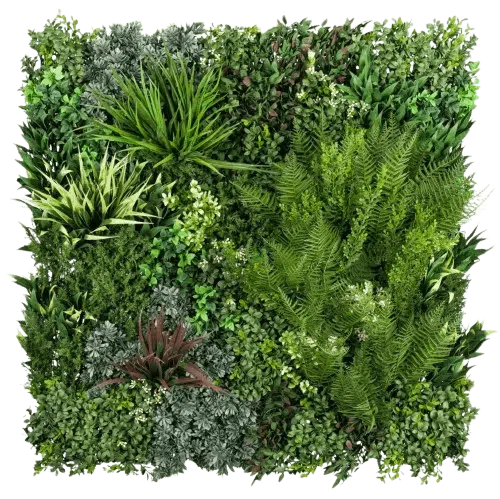 Signature Panel
Our most popular panel with an always-lush look - the ultimate natural backdrop.
Best for: feature walls, living areas, reception spaces
 Essence Panel
A simpler premium-quality mixed foliage panel inspired by our Signature Panels
Best for: fences, gardens, and narrower spaces
 Luxury Flowering Panel
Lush green with a subtle, uplifting bloom-warmth & sophistication.
Best for: terrace & balcony accents, entryways, soft focal points, seating backdrops
 Luxury Boxwood Panel
Perfectly uniform, refined greenery - polished, hedge- like finish.
Best for: formal backdrops, brand walls, privacy screens

Green Walls for Cruise Ships: Lush Greenery at Sea, Without the Maintenance Burden

Artificial Green Wall Specification Guide

How Artificial Green Walls Are Made: Behind the Scenes at Vistafolia
 English (UK) English (UK)
 English (United States)
 French