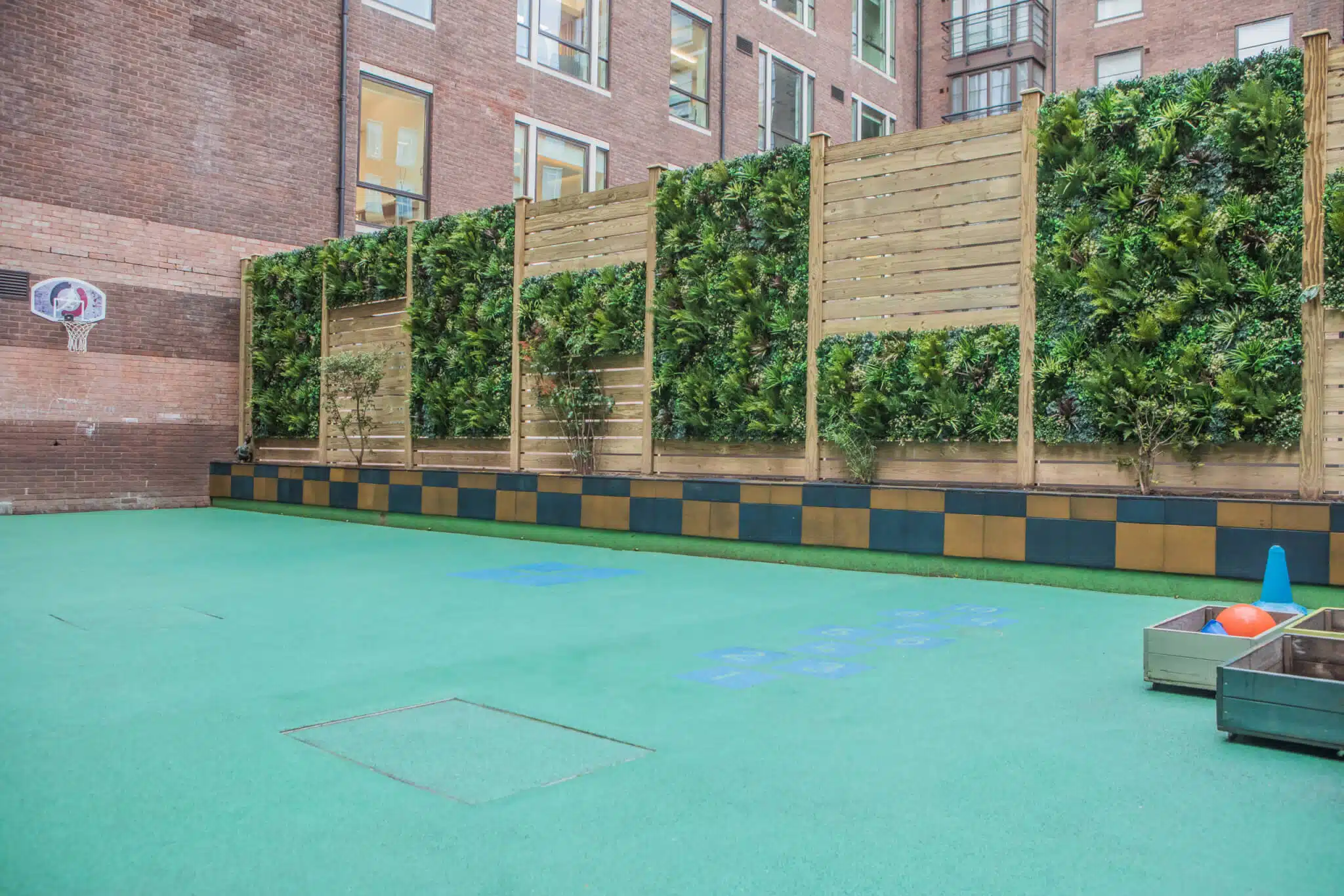

Green walls for schools have become one of the more practical answers to a long list of competing priorities that schools have always had to balance. Budgets are tight, buildings are often decades old, and every square metre of a site tends to be fought over between classrooms, playgrounds, parking and storage. Greenery rarely makes it to the top of that list, not because it doesn’t matter, but because it usually comes with commitments that schools simply don’t have the time or staff to take on.
This is where artificial green walls for schools have started to make a genuine difference. Rather than asking a site team to maintain a living wall alongside everything else on their plate, an artificial system delivers the same visual and wellbeing benefits without the ongoing horticultural workload. For many schools and universities, that combination of appearance, practicality and safety is proving hard to ignore.
The appeal isn’t simply cosmetic. Well specified green walls for schools can support pupil wellbeing, help with safeguarding along a site perimeter, meet fire safety expectations that schools are rightly strict about, and solve a genuine practical problem for buildings in dense urban settings where light and outdoor space are both in short supply.
Independent schools have an additional reason to pay attention. When you’re asking parents to commit significant fees, the physical environment becomes part of what you’re selling, and a tired fence or bare wall does the opposite of that job.
There is a growing body of academic research looking at how views of nature and exposure to greenery affect children in educational settings. A widely cited study by Li and Sullivan (2016) found that pupils given a view of greenery from a classroom window showed improved concentration and reduced stress and heart rate compared with those looking out onto built surfaces alone. A systematic review published in the International Journal of Environmental Research and Public Health examined the wider evidence base and found a consistent pattern linking green space exposure at school with improvements in attentional capacity, stress levels and, in some studies, academic outcomes, although the researchers were careful to note that results across the literature remain mixed and the size of the effect varies considerably between studies.
It’s worth being honest about that nuance rather than overstating the case. The evidence doesn’t suggest that greenery alone transforms outcomes, but it does point consistently in one direction: pupils who can see or spend time around natural looking greenery tend to fare better on measures of attention and stress than those who can’t. For a school considering how to use a stretch of otherwise blank wall or fencing, that’s a meaningful factor to weigh up alongside the purely visual appeal, and it’s a large part of why green walls for schools have moved from a nice-to-have to something senior leadership teams are actively asking facilities staff to look into.
None of this requires living planting to achieve. The research behind the wellbeing case is about visual exposure to convincing greenery rather than the biological presence of living plants specifically, which is exactly why a high quality artificial system can deliver much of the same benefit without the horticultural commitment that comes with the real thing.
Ask any facilities or site manager what puts them off a living wall and maintenance will usually be the first answer. Irrigation systems need checking, plants need feeding and pruning, and anything that fails tends to fail visibly, right in front of parents, governors and Ofsted inspectors on the way through reception.
Schools rarely have a spare budget line for an ongoing horticultural contract, and even where one exists, it’s often one of the first things cut when money gets tight and living walls don’t offer the option of simply stopping maintenance without the wall visibly deteriorating. An artificial system removes that entire category of cost and risk. Once installed, a Vistafolia green wall needs little more than an occasional wash down or dusting. There’s no irrigation to maintain, no seasonal die back to explain away, and no risk of a beautiful launch photo turning into a patchy, embarrassing feature two years later.
This is one of the strongest practical arguments for choosing green walls for schools over a living alternative. A governing body approving capital spend wants to know that the finished result will still look as good in year five as it did on installation day, without a recurring line item appearing on next year’s budget request.
Perimeter security is a constant consideration for schools, and a plain chain link or mesh fence rarely does much for either privacy or first impressions. Many schools are now using green walls along boundary fencing to screen the site from the street, reducing sightlines into playgrounds and outdoor areas while still allowing the fence itself to do its structural job.
This has an obvious safeguarding benefit, since it becomes harder for passers by to observe pupils at play or approach the fence line unnoticed. It also softens what is often one of the least attractive parts of a school site, turning a purely functional boundary into something that contributes positively to the overall environment rather than detracting from it. Of the various reasons schools give for exploring green walls for schools in the first place, perimeter privacy is consistently one of the first mentioned, often alongside safeguarding as a joint priority rather than an afterthought.
Fire safety is treated with particular seriousness in school buildings, and rightly so, which makes it one of the first things worth checking when comparing green walls for schools from different suppliers. Building Bulletin 100, the Department for Education’s guidance on fire safety design for schools, sets out detailed expectations for how school buildings should be designed and finished to reduce fire risk and support safe evacuation. Any material being considered for use on or near a school building, including decorative finishes like a green wall, needs to be able to demonstrate its fire performance rather than simply claim it.
This is an area where quality varies enormously between suppliers. Vistafolia’s systems are independently tested and classified to both EN 13501-1:2018 and ASTM E84, with fire retardant properties compounded into the material itself during manufacture rather than sprayed onto the surface afterwards. That distinction matters over time, because a surface treatment can wear away with weather and handling in a way that a compounded property cannot. For a school specifying a green wall, being able to point to genuine, independently tested fire performance rather than a marketing claim is not a nice to have. It’s essential, and it’s one of the questions any procurement process for green walls for schools should ask before a supplier is shortlisted.
Space and light are two things that many inner city schools simply don’t have much of. Research from the Pathways to Equitable Healthy Cities project found that nearly 400,000 pupils in London, around 30 percent, attend schools with less than 10 square metres of open space per pupil, the minimum recommended by the Department for Education, and that more than 800,000 pupils, roughly 60 percent, attend schools with less than 10 square metres of green space per pupil. The same research found this shortage to be especially concentrated in Inner London boroughs including Southwark, Lewisham, Camden, Hackney and Tower Hamlets, where land is expensive and building footprints leave little room for planting.
Many of these sites are also heavily overshadowed by surrounding buildings, which rules out most forms of living planting even where space can be found. This is precisely the kind of setting where green walls for schools offer a genuine advantage over living alternatives. An artificial system doesn’t need direct sunlight to thrive, so it performs just as well on a shaded, boxed in courtyard as it does on a south facing wall. For schools working with cramped, light starved urban sites, that flexibility can be the difference between having no greenery at all and having a wall that genuinely transforms how a space feels.
The same London research also found that fee paying schools tend to have less open and green space than non fee paying schools, largely because they’re often built on smaller, more expensive plots of land. That’s a useful thing to know, because it means many independent schools are dealing with exactly the space and light constraints described above, at the same time as facing higher expectations around presentation.
Parents visiting on open days or accompanying their children to interviews are, consciously or not, forming an impression of the school from the moment they walk through the gate. A tired fence line or an unconvincing artificial hedge sends entirely the wrong signal at a moment when a school is asking families to commit substantial fees. This is not the place to choose a budget product. Cheap artificial greenery tends to look exactly like what it is from a distance of a few metres, with flat colour, repetitive patterns and foliage that fades or degrades quickly outdoors. For an independent school, investing in a genuinely premium, realistic system is part of protecting the overall impression the school works hard to create everywhere else, and it’s worth treating green walls for schools in this category as a presentation investment rather than a landscaping afterthought.
Vistafolia’s artificial green wall panels are hand-designed in the UK by an award winning horticulturist and hand assembled at our factories, with each panel built from around 65 to 72 individual plants to avoid the flat, repetitive look of lower quality products. Every system carries a five year warranty and has been independently tested for UV stability and fire performance, giving schools and facilities teams the kind of documented evidence that governors, inspectors and procurement processes tend to ask for.
Our fixing systems have also been tested to withstand hurricane force wind conditions, which matters for exposed perimeter fencing and rooftop or courtyard installations where a school building can create its own wind tunnel effects. Combined with a portfolio of school and educational installations already in place, it means a school considering green walls for schools for the first time isn’t taking a leap of faith on an unproven product, but choosing a system with a track record already established in comparable settings.
Why not check out this case study from the prestigious Abercorn School in Central London, or this project at Georgetown University in Washington DC.
Whether you’re looking to improve pupil wellbeing, add privacy along a perimeter fence, solve a shaded courtyard that nothing else will grow in, or simply create a better first impression for prospective parents, Vistafolia can help you find the right solution. We’ve worked with schools facing all of these challenges, and we’re always happy to talk through what green walls for schools could look like on your specific site. Get in touch with our team to discuss your budget and your priorities, and we’ll talk you through what’s possible.
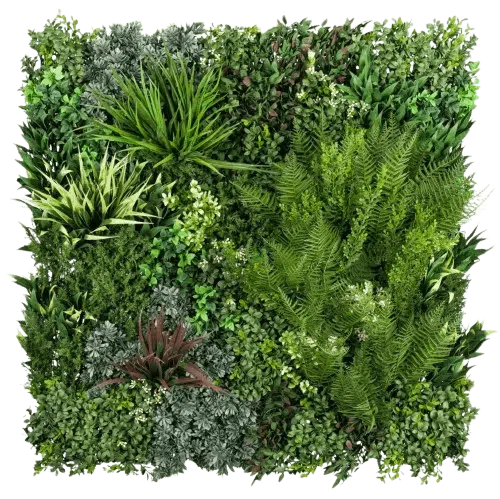 Signature Panel
Our most popular panel with an always-lush look - the ultimate natural backdrop.
Best for: feature walls, living areas, reception spaces
 Essence Panel
A simpler premium-quality mixed foliage panel inspired by our Signature Panels
Best for: fences, gardens, and narrower spaces
 Luxury Flowering Panel
Lush green with a subtle, uplifting bloom-warmth & sophistication.
Best for: terrace & balcony accents, entryways, soft focal points, seating backdrops
 Luxury Boxwood Panel
Perfectly uniform, refined greenery - polished, hedge- like finish.
Best for: formal backdrops, brand walls, privacy screens

Green Walls for Cruise Ships: Lush Greenery at Sea, Without the Maintenance Burden

Artificial Green Wall Specification Guide

How Artificial Green Walls Are Made: Behind the Scenes at Vistafolia
 English (UK) English (UK)
 English (United States)
 French