
When a living wall goes into a scheme, the figure everyone remembers is the installation quote. Living wall maintenance costs arrive later, in smaller instalments, usually under a different budget line and often long after the people who specified the wall have moved on to other projects. By year three or four they can add up to a very unwelcome surprise.
This guide is for developers, landlords, owners and facilities managers who are weighing up a living wall, or who already have one. It covers where living wall maintenance costs actually come from, the situations that push them higher, what happens when a wall fails, and why a quality artificial system can cost less than people expect, even up front. Living walls can be wonderful, and where genuine biodiversity is the goal they offer something an artificial wall never can. The aim here is simply to make sure the full cost is on the table before a decision is made.
A living wall is a garden that happens to be vertical, and it needs the same ongoing care as one, with the added complication of an irrigation system running behind it. In practice, living wall maintenance costs usually cover regular visits to prune, feed and inspect the planting, servicing of the irrigation and control equipment, replacement of plants that fail or outgrow their position, and monitoring to catch problems before they spread.
Putting a reliable number on living wall maintenance costs is harder than it sounds. Our specification whitepaper notes that a 2021 review of the quantitative evidence found green wall costs to be sparsely studied and highly variable between sources, so any single figure should be treated with caution. The structure of those costs is clearer than their size. As the whitepaper sets out, living walls concentrate cost in operation and maintenance, covering irrigation, horticultural care, seasonal replanting and the monitoring that insurers now expect.
What matters, then, is the pattern rather than a headline figure. Living wall maintenance costs are not a one-off line in the budget. They recur for as long as the wall exists, they rise with the difficulty of reaching and caring for it, and they rarely appear in the original quote, which is why they deserve a proper line in the business case rather than a footnote. A sensible habit is to ask any supplier for the expected annual maintenance cost, the replacement cycle for plants and irrigation components and the length of the contract, then project those figures over ten years using the whole-life costing structure in ISO 15686-5 that our whitepaper applies.
For most living walls, maintenance is not really optional, and it rarely comes as a one-off. Insurers set clear expectations. Aviva’s loss prevention guidance on living walls and roofs recommends a formal, recorded maintenance plan, and its separate guidance on living wall design calls for contingency watering plans in case the irrigation fails.
The scale of living wall maintenance costs, and the commitment behind them, is visible in public procurement. A London Borough of Sutton tender to maintain a single living wall and its irrigation system was advertised as a service contract worth £40,000 to £50,000, running over several years with a break clause after three. That is one wall on one building, and it is a useful reminder that a living wall comes with a long term service relationship rather than a single purchase. If the contract lapses, the wall doesn’t pause politely. It deteriorates, and a deteriorating living wall brings risks of its own.
Some of the biggest line items in living wall maintenance costs are the ones that never appear in the original quote. A 2013 life cycle cost study of vertical greening systems by Perini and Rosasco modelled a six-system comparison on an office building in Genoa. Its assumptions for the living wall system included replacing around 5 per cent of the panels and 10 per cent of the plants every year, and replacing the irrigation pipework every 7.5 years because salts crystallise in the lines. It found that living wall systems carried both the highest installation costs and the highest maintenance costs of the systems studied, and even after counting benefits such as energy savings and higher rental income, the living wall system showed no margin of economic sustainability in any of the three scenarios modelled.
It’s worth being fair about what that study is. It models one building, using 2013 Italian prices, so it doesn’t prove that every living wall is uneconomic. But the pattern of costs it describes, with replacement panels, replacement plants and replacement pipework all recurring year after year, is the pattern facilities teams will recognise. Add water and energy for pumps and controllers, and the cost of the irrigation system itself becoming a maintenance item, and living wall maintenance costs look rather less like a line item and more like a standing liability.
Where the wall is located makes a big difference to what it costs to look after. A wall high up a building can’t be maintained from the ground, so taller walls may need a scissor lift, scaffold tower or similar access equipment for every visit. Every visit then adds specialist access equipment to living wall maintenance costs, on top of the cost of the horticulturist, and the higher the wall, the more that adds up over a ten year period. Aviva’s guidance recommends locating a living wall where it is accessible for maintenance and inspection, which is not always possible on a scheme where the best position for the feature is also the hardest one to reach.
Sun and wind work in a similar way. A wall in a location with too much direct sun can scorch, dry out faster and demand more water, and an exposed, windy position can desiccate foliage and put extra strain on the irrigation lines. In both cases the plants that looked right on the drawings are replaced more often than anyone planned for, and living wall maintenance costs start to climb well beyond the original estimate. Owners often only find this out once the wall is up, which is the worst moment to be learning it.
The largest entry in any list of living wall maintenance costs is the one nobody puts in the budget, which is failure. Picture a property developer who specifies a living wall for the entrance of a new residential scheme. The wall looks superb on handover, and the client moves in. A few months later the client goes away for a long stay. While they are gone there is a power cut, and the irrigation controller is switched off. Nobody notices, because nobody is there.
By the time anyone is back, the wall is dead. Nobody has done anything wrong. It is the sort of thing that can happen to a well-managed wall, because the whole system depends on water arriving every day of the year. But the consequences land on the owner all the same, and they land hard. A wall of dead plants can’t realistically be revived. Fixing it generally means stripping the wall back and replanting, which in practice is closer to a full replacement than a repair, with new plants, labour, access equipment, disposal of the old planting and a wall that is out of action while it happens. That can be a bill on the scale of the original installation, and it is the hidden end of living wall maintenance costs: it can arrive with no warning at all.
This is a known risk. Aviva’s guidance on living walls states that failure of the irrigation system is a primary cause of damage to the living wall. One of the UK’s first living walls, on a children’s centre in Islington completed in 2006, did not last long, and a look at why green walls die in the Architects’ Journal notes that living wall suppliers argue failures usually come down to poor management. That is a fair point, and it is exactly the issue. A living wall’s health depends on management being faultless, every day, for as long as it exists. There is also a fire safety dimension, because Aviva notes that planting which dries out becomes susceptible to ignition, which is why a dead wall is a larger problem than an unattractive one.
None of this means a living wall is the wrong choice. Where a client genuinely wants biodiversity, living planting is the only way to achieve it, and the right response is to budget realistically for a maintenance contract, a contingency watering plan and a replacement fund. What matters is going in with open eyes.
One of the more surprising things for clients comparing the two is the upfront figure. Many people assume a premium artificial wall must cost more to install than a living one, because it feels like the more finished product. Depending on the specification, it often doesn’t. A living system brings an irrigation network, a water supply, drainage and a structure that has to carry growing media and water, and all of those are costs from day one. A Vistafolia panel system has no plumbing, no water on the wall, no tank and no controller, and it can go up quickly. At the Hothfield Rehabilitation Centre in Kent, more than 300 square metres of Vistafolia panels transformed a bare brick courtyard in just over two weeks, after the client dismissed natural planting because of the upkeep and ongoing costs involved. Put those savings next to a decade of living wall maintenance costs and the comparison looks very different from the one in the original quote.
Once installed, the running costs are modest. A Vistafolia wall needs little more than an occasional dust or hose down, with no irrigation contract and no plants to replace. That is the central difference in how the costs are distributed over time: an artificial wall front loads its cost and then stays quiet, while a living wall starts with an installation bill and then keeps sending new ones.
None of this is an argument for choosing the cheapest artificial option, which can turn out to be the most expensive. In an illustrative scenario in our specification whitepaper, a 50 square metre economy artificial wall at £150 per square metre that needed replacing twice in ten years cost £27,500 in total, against £17,500 for a premium system at £350 per square metre that lasted the whole period, before counting any disruption. Those are generic figures rather than Vistafolia pricing, and the result moves with the assumptions: on the paper’s figures the two cost the same if the economy product needs just one replacement, and if the premium system itself needed replacing, the economy option would come out cheaper. That is exactly why evidence of how long a product will really last matters more than the headline price. Our guide to the six questions to ask before specifying a green wall is a good way to test any quote.
Businesses are under more pressure than ever to be seen making greener choices, and a living wall can look like the obvious way to show it. That makes it all the more interesting that organisations with sophisticated design and facilities teams have looked at the options, including living wall maintenance costs, and chosen Vistafolia instead.
Starbucks used a Vistafolia green wall to clad the exterior of its store at the Children’s Medical Centre in Dallas. Twinings chose Vistafolia for its tea shop on The Strand in central London, which has been trading from the same site since 1706. Christian Dior used a Vistafolia wall in the staff breakout area of its Bond Street flagship, where a darkened room ruled out a living wall. The Hilton in Kingston used one to screen noisy air conditioning units from premium rooms, and Heathrow chose Vistafolia for the VIP entrance to Terminal 5, where it needed year-round greening with an absolute minimum of maintenance.
We can’t speak for every client’s reasons, and they differ from project to project. Some will have weighed the long term investment, some won’t have wanted a lifetime of living wall maintenance costs, some had a site that simply couldn’t support living planting, and some may well have been burned by a living wall in the past and decided enough was enough. What they have in common is that each looked at their own situation and decided a quality artificial wall was the better answer. We make no environmental claims for artificial walls, and a living wall can offer real ecological benefits where that is the goal. The point is that the decision was made on the facts of each project, not on a label.
Vistafolia panels are hand-designed in the UK by an award winning horticulturist and hand assembled at our factories, with around 65 to 72 individual plants in each panel so that the finished wall avoids the flat, repetitive look that gives lower quality products away. Every system is independently tested for fire performance and UV stability and backed by a five year warranty, so owners and developers have documented evidence to work with rather than a promise.
If you are weighing up a living wall, or you already have one and living wall maintenance costs have outgrown the plan, get in touch with our team. We can talk through your space, your budget and the whole-life figures, share relevant project examples, and help you decide whether a quality artificial system is the right answer for your project.
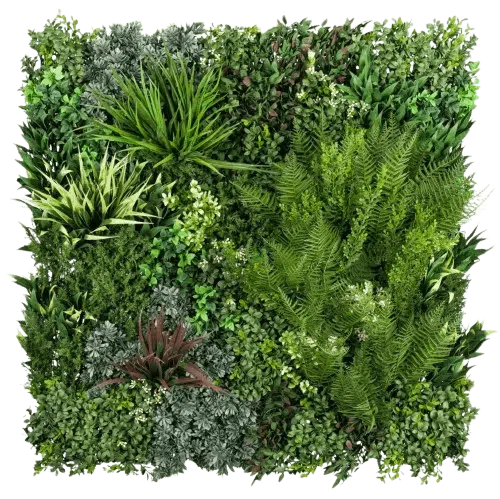 Signature Panel
Our most popular panel with an always-lush look - the ultimate natural backdrop.
Best for: feature walls, living areas, reception spaces
 Essence Panel
A simpler premium-quality mixed foliage panel inspired by our Signature Panels
Best for: fences, gardens, and narrower spaces
 Luxury Flowering Panel
Lush green with a subtle, uplifting bloom-warmth & sophistication.
Best for: terrace & balcony accents, entryways, soft focal points, seating backdrops
 Luxury Boxwood Panel
Perfectly uniform, refined greenery - polished, hedge- like finish.
Best for: formal backdrops, brand walls, privacy screens

Green Walls for Cruise Ships: Lush Greenery at Sea, Without the Maintenance Burden

Artificial Green Wall Specification Guide

How Artificial Green Walls Are Made: Behind the Scenes at Vistafolia
 English (UK) English (UK)
 English (United States)
 French