
Most artificial green walls are chosen the same way. Someone shortlists a few options on appearance, a sample arrives and looks lovely, and then, somewhere between the design team and the purchase order, price takes over. Cheaper alternatives appear, described as equivalent, and the brief quietly shifts from what the wall should do to what it should cost. This is how artificial green wall specification so often ends up being decided on price.
That habit is what our new whitepaper, The Specification Gap, sets out to challenge. We wrote it as a manufacturer, so it is built to be applied to any supplier’s product, including ours. This post is the short version: the main ideas, the five tests the paper proposes and a few honest numbers, written so you can get through it in one sitting. If it raises questions, the full paper has the detail, the references and a tender-ready checklist. Whether you are an architect, an interior designer, a facilities manager or a distributor, the aim is the same, which is to make artificial green wall specification a decision based on evidence rather than on appearance and price alone.
Most building products with safety or longevity implications come with a specification habit attached: standard tests, benchmark documents and a professional instinct to ask for certificates. The category has grown quickly, and artificial green wall specification has largely followed the interiors and fit-out channels where the habit has been aesthetic first and technical second. The result is a market where products of very different engineering quality look almost identical at the point of sale. The photography is similar, the showroom samples are similar, the language is similar, and price is the only visible difference.
The differences that matter show up later, typically somewhere between two and ten years after installation, by which time the specifier has moved on and the owner is left holding the outcome. A wall that fades unevenly in year three doesn’t announce itself as a specification failure. It looks like a maintenance issue, then a replacement cost, and the link back to the original buying decision is rarely drawn. That delay is the specification gap.
The encouraging part is that closing it doesn’t need new regulation or new testing regimes. The standards, the science and the costing methods already exist. What has been missing is a set of questions a specifier can ask in an afternoon, which is exactly what a good artificial green wall specification should contain.
The paper’s blunt answer is that capital price is the least useful number in the specification. The properties that govern how a wall performs over its life, namely how its fire performance is achieved, how its resistance to ultraviolet light is engineered and what maintenance the design assumes, are decided at manufacture. They are largely invisible at purchase, which is why two panels that look the same on a sample board can behave very differently ten years later, and why an artificial green wall specification built on capital price alone tends to disappoint.
Construction research gives a useful sense of how this kind of hidden cost behaves. Analysis of 359 projects in the Construction Industry Institute database found that direct rework costs alone often total around 5 per cent of construction cost (Hwang et al., 2009). It is worth being straightforward about the limits here. That is evidence about construction generally, not about green walls, and no category-specific failure data has been published yet. What it supports is a reasonable hypothesis: that failure costs in this category are under-recorded and tend to land on the owner rather than on whoever made the specification decision.
The whitepaper turns this into five tests for artificial green wall specification. Each can be answered from documents a competent supplier should already hold, and each is vendor neutral by design, so it will expose weak evidence and validate strong evidence from any manufacturer, including us. The tests are sequenced by consequence. The first is a gate, which means a product that doesn’t pass it doesn’t go any further, and no strength elsewhere makes up for it.
Fire comes first in any artificial green wall specification. Start with the classification for the jurisdiction you are working in. In the UK and Europe that is EN 13501-1. In the US, requirements are set by the adopted codes, which commonly accept ASTM E84 for interior finishes and NFPA 701 for decorative vegetation. These are not interchangeable, and a rating from one regime quoted against another regime’s requirement doesn’t answer the compliance question. In England, for example, regulations restrict combustible materials in and on the external walls of relevant buildings, and the thresholds are under review, so the current position should always be confirmed project by project.
Then ask two further questions. Does the test report cover the exact product being supplied, rather than a related product, a loose component or the coating alone? And how is the performance achieved? Flame retardant chemistry can be compounded into the polymer during manufacture, or a treatment can be applied to the finished foliage. A surface treatment depends on keeping an exposed layer intact through years of sunlight, cleaning, abrasion and moisture, and any loss is invisible, because the wall looks identical on the day its classification is intact and on the day it is not. Compounded chemistry is distributed through the material and has no surface layer to lose.
Red flags include a report for a related product, a certificate for the coating rather than the foliage system, and a claim of being fully compliant with no standard named. Whether a classification suits a particular building is a question for the project’s fire engineer and, where required, the approval authority. It is never a question the supplier can settle on their own.
Sunlight breaks down plastics, which makes UV performance a core part of any outdoor artificial green wall specification. Ultraviolet radiation drives a chain of chemical changes that weaken the material and shift its colour, and the speed of that process is set by how the material was formulated. UV absorbers and stabilisers added during compounding slow this down considerably, but they don’t stop it, and how well they work depends on the stabiliser package and how it is built into the material.
So what should you ask for in your artificial green wall specification? Whether UV protection is compounded into the foliage or applied to its surface. A weathering report to ISO 4892-2 or its US counterpart ASTM G155, stating the test cycle and exposure and measuring colour change against a stated acceptance threshold. And a written warranty that actually covers colour change for your territory and exposure. A warranty that excludes fading is telling you what its manufacturer expects. It is also worth remembering that a warranty is a contractual transfer of risk, with exclusions, rather than proof of how long a product will last, so read it alongside the test evidence and not instead of it.
The third test is what makes artificial green wall specification a whole-life question, and it asks for a cost picture you can map to the whole-life costing method in ISO 15686-5: the acquisition cost, the expected service life and the evidence behind it, the maintenance assumed, what would trigger a replacement and what happens at end of life. The red flags are a capital price with no stated service life, and service life claims that run far beyond the warranty with no field or test evidence in between.
Every performance claim in an artificial green wall specification assumes some level of care. The fourth test asks what routine care that is, how often, who can do it and at what access cost, and what the known failure modes and remedies are, including how a damaged module is replaced. In artificial green wall specification, be wary of maintenance free with no definition behind it. For exterior installations there is an additional gate. Evidence for fixings, wind loading, substrate compatibility and corrosion behaviour can’t be inferred from material test data alone, and where it isn’t demonstrated, the sensible answer is not to proceed.
The last test asks whether the answers to the first four can be believed, which is what makes the paperwork part of the artificial green wall specification rather than an afterthought. That means dated certificates from an identified laboratory for the product actually supplied, warranty terms in writing, the supplier’s chemical documentation position (REACH in the UK and Europe, and Proposition 65 for US supply) and consistency between the marketing claims and the certificates behind them. Certificates available on request that never arrive are a warning sign. So are environmental claims without substantiation, which the paper recommends treating with the same scepticism that the UK’s Green Claims Code now formalises, whichever supplier makes them.
Each test is recorded as a pass, clarification required or not demonstrated. A document that exists but shows inadequate performance is not a pass, and at a gate, anything other than a pass means do not proceed.
The paper includes a scenario illustration, built entirely on stated assumptions. It uses generic figures that don’t represent any supplier’s pricing, including ours, and it is nominal and undiscounted, so treat it as a way of seeing how the calculation works in artificial green wall specification rather than as a forecast.
Take a 50 square metre interior wall over ten years. System A is an economy product at £150 per square metre, so £7,500 to install. Its colour performance is assumed to degrade visibly, leading to two replacements over the period, and each replacement costs the same again plus £2,500 for access, making good and disposal. That brings the ten-year total to £27,500. System B is a premium product at £350 per square metre, so £17,500 to install, assumed to stay above the intended appearance standard for the full ten years. Its ten-year total is £17,500.
The more useful result is the break-even. On these figures the two systems cost exactly the same if the economy product needs just one replacement, and the premium system is only cheaper once the economy product needs two or more. And if the premium system itself needed replacing after five years, its total would rise to £37,500 and the economy option would come out cheaper. In other words, everything turns on how many replacement cycles each product will really need, and that is exactly the variable the five tests are designed to put evidence behind. The arithmetic also leaves out the disruption of replacing a wall in a working building and the reputational cost of a visibly tired installation, both of which fall on the owner.
The paper also names the four constructions that recur across the market, because each one raises different questions. None of this is a verdict on any product. It simply points to what to test when comparing products in an artificial green wall specification.
Printed fabric foliage uses printed polyester fixed to board or mesh. The questions here are the light stability of the inks and coatings, and, because wood-based boards are moisture sensitive, whether fire performance depends on an applied treatment that must last. PVC snap-on mats resist ignition better than many common plastics, but their combustion products are dominated by hydrogen chloride and carbon monoxide, so smoke and toxicity need testing alongside the standard fire evidence. Entry-level polyethylene foliage on a polyethylene lattice raises the question of whether UV stabilisation and flame retardancy are actually compounded in, and on what evidence, because unstabilised polyolefins degrade in sunlight and unmodified polyethylene ignites and drips when it burns. Finally, compounded polyethylene on a stainless mesh, the construction Vistafolia uses, integrates the retardant and UV chemistry into the material rather than relying on a surface treatment. Even then, the paper is clear that product-specific classification, weathering evidence, installed configuration and documentation remain decisive.
It is also worth noting that the paper carries no service life figures for any of these families. The authors found no published independent data on failure timing, and that absence is the gap the paper is named after.
The practical changes to artificial green wall specification are modest. Put the criteria into the specification clause itself, covering the fire class and jurisdiction, the weathering test and colour change limit, and the warranty term and what it covers. Review a suitably sized sample, typically 0.5 to 1.0 square metres, under the lighting and viewing distance of the real space. Where the wall is going on an external wall in a prescriptive regime, settle the fire question with the fire engineer before the aesthetic shortlist is drawn up, not after.
Value engineering is where a good artificial green wall specification tends to come unstuck, because a cheaper substitute arrives described as equivalent. Written criteria make that equivalence testable. A substitute is acceptable only if it passes the same five tests with documentation of the same standard as the product originally specified. For facilities and commercial teams, the shift is to compare proposals over a stated period using the ISO 15686-5 structure rather than on capital price, and for distributors and trade partners, the same framework works as a tool for choosing what to stock.
This post covers the ideas. The full paper adds the evidence and references behind each claim, the regulatory landscape in the UK, EU and US, the detail of the cost scenario and a tender-ready specification checklist in Appendix A, which records the evidence and outcome for each test in a form that can be attached to a tender return. It is written to be applied to any supplier’s product, and it is well worth reading before your next artificial green wall specification goes out to tender. You can read The Specification Gap here.
A manufacturer could simply ask you to trust the product. We would rather help you check it. That is why we published the framework, why it is written to be applied to any supplier, and why we encourage specifiers to run the five tests on our documentation exactly as they would on anyone else’s.
On the product side, flame retardant chemistry and UV stabilisers are integrated into our foliage during manufacture rather than applied as a surface treatment, the plants are fixed to a stainless steel grid, and our five year limited warranty has terms that address colour change under UV exposure against a stated grey scale threshold. Routine care is periodic cleaning, with no irrigation or replacement planting. The documentation behind all of it, including the reaction to fire classification reports for the markets we supply, the weathering report, the warranty terms and our chemical documentation, is available as part of the technical due diligence process, and we will confirm exactly what applies to the product, market and installation you have in mind.
Just as important, we are committed to helping people make the right choice through education, not only through the products we make. The whitepaper, our guide to the six questions to ask before specifying a green wall, our look at how artificial green walls are made and tested, our step by step installation guide and the technical documents and training videos on our website are all designed to help you avoid the common pitfalls of artificial green wall specification, whichever supplier you end up choosing.
If you are working on an artificial green wall specification and would like a second opinion, or want to request the technical evidence pack for a specific project, get in touch with our team or email info@vistafolia.com. We are always happy to talk it through.
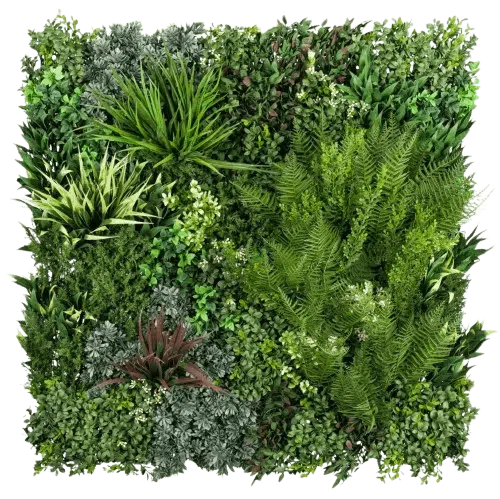 Signature Panel
Our most popular panel with an always-lush look - the ultimate natural backdrop.
Best for: feature walls, living areas, reception spaces
 Essence Panel
A simpler premium-quality mixed foliage panel inspired by our Signature Panels
Best for: fences, gardens, and narrower spaces
 Luxury Flowering Panel
Lush green with a subtle, uplifting bloom-warmth & sophistication.
Best for: terrace & balcony accents, entryways, soft focal points, seating backdrops
 Luxury Boxwood Panel
Perfectly uniform, refined greenery - polished, hedge- like finish.
Best for: formal backdrops, brand walls, privacy screens

Artificial Greenery for Small Spaces: Big Impact in Bathrooms and Home Offices

Green Walls for Cruise Ships: Lush Greenery at Sea, Without the Maintenance Burden
Artificial Green Wall Specification Guide
 English (UK) English (UK)
 English (United States)
 French