
Most people only ever see the finished wall. It arrives on site, goes up on a Tuesday, and looks wonderful by Wednesday. What they don’t see is everything that happened before the panels were ever boxed up, and that is where most of what determines how a wall will look and perform in five years is decided.
This is a behind the scenes look at how artificial green walls are made at Vistafolia, from choosing the plants to the tests every design goes through. Along the way we’ll explain why each step matters, because the details that make the biggest difference to a green wall are often the ones you can’t see in a showroom sample. We touched on the design side in our article on the science of artificial greenery, and this piece goes further into the process and the tests. It is also a theme we explore in depth in our specification whitepaper, which argues that the properties which decide whole-life performance are set at manufacture and are largely invisible at the point of purchase.
Before a single panel is assembled, the plants themselves have to be right. Every Vistafolia product begins life in the UK, where it is designed by hand by our award winning horticulturist. Each panel is built from around 16 different plant varieties, chosen and refined so that they look convincing up close and from across the room. Leaf shapes, colours and textures are balanced the way they would be in a real planting, with deeper greens, lighter highlights and a mix of larger and finer foliage, rather than a single leaf repeated across a whole wall.
Just as much care goes into how one panel meets the next. Vistafolia walls use a three-panel system, with panels labelled A, B and C that are fitted in a random order, and each panel has a small amount of planting overlap built in at its edges. Why does this matter? Because the two things that give a poor quality artificial wall away are obvious repetition and visible join lines. A pattern that repeats every 80 centimetres looks manufactured, and a gap or colour change at the edge of each panel draws the eye to exactly the place you want it to ignore. Designing the plants so that each panel blends into its neighbour avoids unnatural shapes and colours and removes the join lines, so that a finished installation reads as one continuous wall.
Once the plants are chosen, the panels are assembled by hand at our factories, which is the heart of how artificial green walls are made at Vistafolia. Each stem is positioned and secured individually, using between 65 and 72 plants per panel, rather than being moulded or stamped as a single sheet.
Why does hand assembly matter? Mainly because of the human connection. When skilled people handle every panel as it is built, they can spot problems as they go: a stem that isn’t sitting properly, a patch where the colour balance is off, a connection that doesn’t feel secure. A process that treats every panel as an identical unit tends to pass those problems along. A person looking at the panel in front of them is much more likely to catch them before the panel moves on.
The plants are fixed using stainless steel cable ties onto a powder coated stainless steel grid. Both choices are about longevity. Plants that are tied securely to a strong grid stay put through years of wind, handling and temperature changes, which is where weaker connections tend to loosen. Stainless steel also resists corrosion far better than ordinary steel, and the powder coating adds a further layer of protection, which reduces the risk of rust staining or weakening over time. It is also relatively light, so a standard 80 centimetre by 80 centimetre panel weighs around 5 to 6 kilograms, which makes panels easier to handle on site and puts less load on the wall behind them.
It is also worth knowing that not all artificial greenery is built this way. Cheaper products are often backed with lightweight plastic rather than a stainless steel grid, which is more prone to warping or sagging over time and can hold fixings less securely. From a distance the two can look similar. The difference tends to show up years later.
Quality control is the least visible part of how artificial green walls are made, and one of the most important. Before any Vistafolia panel leaves the factory, it goes through rigorous quality checks. Why? Consistency. A client who orders a hundred panels needs the hundredth to look and perform exactly like the first, and a wall that is installed in two phases, perhaps months apart, needs the later panels to match the earlier ones. Checking quality at the source, before panels are boxed and shipped, is what makes that consistency possible, and it is far easier than discovering a problem once a panel is on a wall.
Alongside how they are built, the other half of how artificial green walls are made well is how they are tested. Vistafolia panels go through three main tests, starting with fire, which is the first thing to get right in how artificial green walls are made for commercial spaces.
Fire performance is tested to EN 13501-1, the fire classification standard used in the UK and Europe, and NFPA 701, which is used in the United States. In both cases, the panels are tested under strict criteria and graded on how they perform under those conditions. This matters for a practical reason as well as a safety one: because the criteria are standardised, the results can be compared like for like with other products, which takes the guesswork out of choosing between them.
Why does this matter? The reasons are obvious, but they are worth stating plainly. A product that hasn’t been tested to a recognised standard is an unknown quantity, and unknown is not something you want when a material is going to be installed in a hotel lobby, an office, a school or an airport terminal. Commercial settings in particular tend to be busy, enclosed and full of people, and the risks associated with non fire rated products are real. Choosing a product with documented fire performance is one of the simplest ways to avoid them.
Two honest caveats apply, and they apply to every manufacturer. Fire test results describe how a product performed under a particular test method and configuration, which isn’t the same as a universal approval for every building. Requirements also differ between the UK, Europe and the US. Whether a particular classification is suitable for a specific project is a question for that project’s fire engineer and, where required, the approval authority. For that reason we recommend asking any supplier for the test report that covers the exact product being supplied.
The second test is ultraviolet exposure. Sunlight is relentless on plastics, and over time UV light breaks down the material and fades its colour. For a green wall that is expected to look good for years, that is a major risk, particularly on a south facing wall or an exposed outdoor location.
To find out how a product copes, which is a key part of how artificial green walls are made to last, the panels are tested to BS EN ISO 4892-2, which exposes samples to intense, controlled light in a UV test chamber. Samples are exposed to the equivalent of five years of outdoor exposure, and the colour change is then measured.
Why does this matter? Confidence in how the product will perform over time. A showroom sample tells you what a panel looks like on day one. It tells you nothing about year five. A UV test measures it, and it also gives you something to compare. It is worth being straightforward that accelerated testing is a guide rather than a guarantee, because real conditions vary from site to site, and UV stabilisation slows colour change rather than eliminating it. That is why it makes sense to read a test result alongside the warranty terms, and why Vistafolia’s panels carry a five year warranty.
The third test is freeze and thaw. In this test, panels are put through repeated cycles of freezing and thawing to see how the product behaves, in particular whether it degrades, cracks or falls apart. The test follows MIL-STD-810G Method 524.
Why does this matter? It is mainly relevant in harsh environments, where a wall may be exposed to deep cold, ice and rapid temperature swings. In those conditions plastics that perform well in mild weather can turn brittle and fail. Putting panels through repeated freeze and thaw cycles in the lab means the risk of failure in icy conditions is minimal before the panels ever reach a building. If you want to know how artificial walls behave through the colder months, our guide to artificial green walls in winter covers it in more detail.
There is also the question of wind. Panels are tested to withstand wind pressures of plus or minus 7,600 pascals, which is equivalent to wind speeds of around 400 kilometres per hour. That is a test of the panel system rather than the wall it is fixed to, so the fixings and the structure behind it still matter, and we are always happy to talk through the right fixing method for a specific site.
Taken together, how artificial green walls are made and tested at Vistafolia means that when you choose a panel, you’re choosing more than a look. You are choosing a product whose plants were designed to blend, whose panels were put together by people who can spot a problem, and whose performance has been measured rather than assumed.
However you look at how artificial green walls are made, and whoever you buy from, the same questions are worth asking. Which standards has the product been tested to, and does the test report cover the exact product being supplied? How is fire performance achieved? How is UV stability built in, and how was it tested? What does the warranty cover? Those questions, and a framework for weighing the answers, are set out in full in our specification whitepaper, which is written to be applied to any vendor’s product and is well worth a read before you specify. To request the technical evidence pack for a specific project, contact info@vistafolia.com.
If you would like to know more about how artificial green walls are made at Vistafolia, or want to talk through a project, get in touch with our team. We can share test documentation, talk through the process, and help you choose the right panels for your space.
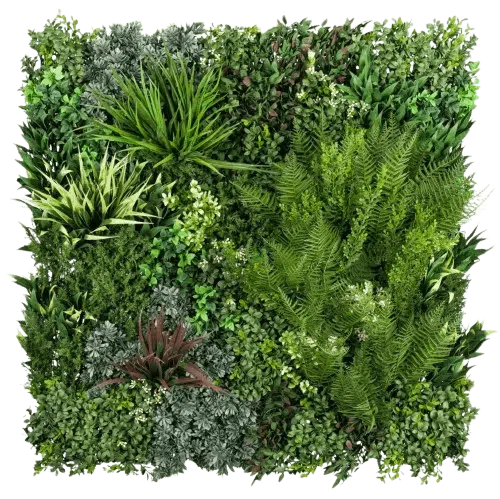 Signature Panel
Our most popular panel with an always-lush look - the ultimate natural backdrop.
Best for: feature walls, living areas, reception spaces
 Essence Panel
A simpler premium-quality mixed foliage panel inspired by our Signature Panels
Best for: fences, gardens, and narrower spaces
 Luxury Flowering Panel
Lush green with a subtle, uplifting bloom-warmth & sophistication.
Best for: terrace & balcony accents, entryways, soft focal points, seating backdrops
 Luxury Boxwood Panel
Perfectly uniform, refined greenery - polished, hedge- like finish.
Best for: formal backdrops, brand walls, privacy screens

Artificial Greenery for Small Spaces: Big Impact in Bathrooms and Home Offices

Green Walls for Cruise Ships: Lush Greenery at Sea, Without the Maintenance Burden

Artificial Green Wall Specification Guide
 English (UK) English (UK)
 English (United States)
 French