
Biophilic design has become one of the defining trends in fitness space design over the last few years, and it’s easy to see why. Gyms, fitness studios, yoga and pilates spaces are increasingly being designed to feel less clinical and more restorative, and greenery is usually near the top of the list of ways to achieve that. The difficulty is that a gym or studio environment is one of the more hostile settings imaginable for actual living plants, which is exactly why green walls for gyms are increasingly artificial rather than living.
This isn’t limited to large commercial gym chains. Boutique fitness studios, spin rooms, boxing gyms, climbing centres, and yoga and pilates spaces are all wrestling with the same basic tension: members increasingly expect an environment that feels calm, natural and considered, while the physical realities of running a fitness business, heat, humidity, heavy equipment and relentless foot traffic, make that genuinely difficult to deliver with living planting. Green walls for gyms and studios of every kind have become one of the more practical ways to close that gap.
Most fitness spaces are kept deliberately cold through air conditioning during busy sessions, then can swing to warm and humid as a room fills with people working hard. Studios running back to back classes often see repeated temperature swings throughout the day, and that kind of fluctuation is exactly what living plants tend to dislike most. Add in the recirculated air that air conditioning systems produce, which is typically drier than a plant’s natural environment, and you have a set of conditions that make consistent, healthy growth genuinely difficult to sustain.
Layer on the practical realities of a working fitness space, including limited natural light in many studios, heavy foot traffic, the occasional stray kettlebell or resistance band, and a cleaning regime built around sweat and hygiene rather than horticulture, and it becomes clear why so many well intentioned living walls in gyms end up patchy, wilting or removed entirely within a year or two.
None of this is a criticism of the plants themselves. It’s simply a mismatch between what living systems need to thrive and what a functioning fitness business is actually optimised for. A gym’s climate control exists to keep members comfortable during exercise, not to maintain stable growing conditions, and asking the two priorities to coexist indefinitely tends to end with either the plants or the air conditioning losing out. This is the practical starting point for why green walls for gyms so often end up being the more realistic long term choice, rather than a compromise on the original biophilic ambition.
There is a genuine, growing body of research connecting exposure to greenery with both mental wellbeing and exercise itself, which is precisely why fitness spaces have taken such an interest in biophilic design in the first place, and why green walls for gyms have moved from a decorative afterthought to something operators actively research before fitting out a new site.
The strongest single piece of evidence anyone weighing up green walls for gyms should know about comes from Barton and Pretty (2010), who analysed data from over a thousand participants across ten UK studies and found consistent improvements in mood and self-esteem from physical activity carried out in the presence of natural, green surroundings. It’s worth being precise about what this research actually covers: the original studies were mostly conducted outdoors, in parks, woodland and other natural settings, rather than inside a gym. The relevant question for an indoor fitness space is whether some of that benefit can be brought inside through biophilic design, including green walls, rather than assuming an exact equivalence.
That question is now being studied directly. A peer reviewed paper on biophilic design in sports facilities found that incorporating natural elements such as greenery and visual access to nature into gyms and fitness centres was associated with greater exercise immersion and improved psychological resilience among users. Separately, Colorado State University has run a controlled clinical study specifically comparing treadmill performance, heart rate, oxygen consumption and perceived exertion between a biophilic gym environment and a standard one, aiming to establish more precisely whether natural elements in a workout space can make exercise feel easier or more enjoyable, and whether that translates into measurable performance differences.
None of this suggests that a green wall alone transforms athletic performance, and it would be overselling the evidence to claim otherwise. What the research does support is a genuine, biologically plausible connection between natural surroundings and both the enjoyment and the perceived effort of exercise, which is a meaningful consideration for anyone designing or fitting out a fitness space, whether that’s a large commercial gym, a boutique studio or a yoga and pilates space built around calm as much as exertion.
Where this becomes practically useful is in member experience and retention rather than any claim about performance gains. A studio that feels calmer, more considered and less clinical tends to be a studio people want to return to, and green walls for gyms are one of the more cost effective ways to shift that feeling without a full interior refit.
Fitness spaces have become some of the most photographed and filmed commercial interiors around, and green walls for gyms are increasingly designed with that in mind from the outset. Members document their sessions, studios promote classes through social content, and a strong visual identity has become a genuine part of how boutique fitness brands compete for members in a crowded market.
A green wall works particularly well in this context because it photographs well from almost any angle and gives a studio a natural backdrop that doesn’t compete with branding the way a plain painted wall or an exposed brick feature sometimes can. Many gyms and studios are now combining green walls with logo signage set into or in front of the foliage, creating a single feature that reinforces brand identity in every piece of content a member posts, while still looking considerably more inviting than a branded vinyl wrap on its own.
This matters more in fitness than in most other commercial settings, because so much of a studio’s marketing is generated for free by its own members. A well designed green wall positioned near the entrance, the reception desk or a popular training area becomes an informal photo spot without anyone needing to ask for it, and every post tagged with the studio’s location doubles as advertising. For a studio relying on word of mouth and social sharing to bring in new members, investing in green walls for gyms that also carry branding earns its space on the wall in a way that’s easy to justify against almost any other interior spend.
Gyms and fitness studios are high-occupancy commercial spaces, often with dozens or hundreds of people moving through a facility over the course of a day, which makes fire safety a genuine consideration rather than a formality, and one that any operator specifying green walls for gyms should raise directly with a prospective supplier rather than assume is covered.
This is another area where the gap between living and artificial systems matters more than it first appears. A living wall’s fire performance, where it exists at all, is generally only valid while the plants themselves are alive and adequately hydrated. Dry, dying vegetation is considerably more combustible than the healthy material a system may originally have been rated against, which is a particular risk in a space where irrigation systems can be affected by heat, humidity swings and the kind of intermittent attention a busy gym environment tends to produce. This is exactly the risk that artificial systems remove. Vistafolia’s green walls for gyms are independently tested and classified to EN 13501-1:2018 and ASTM E84, with fire retardant properties compounded into the material during manufacture rather than applied as a surface treatment that can wear away over time and repeated cleaning.
This is another area where green walls for gyms solve a problem that living planting simply can’t. A significant number of gyms and fitness studios operate with little or no natural light, often by necessity rather than choice. Spin studios, boxing gyms and strength facilities are frequently located in basements or windowless units where rent is cheaper and soundproofing is easier to manage, and yoga or pilates studios above ground floor retail units often have similarly limited access to daylight.
This is precisely the kind of setting where a living wall becomes almost impossible to sustain, regardless of how carefully it’s specified, since even shade tolerant species need some usable light to survive long term. An artificial green wall has no such requirement. It looks the same in a sunlit reception area as it does in a basement spin studio with no windows at all, which makes it one of the few practical ways to introduce genuine greenery into exactly the kind of space that would benefit from it most, but has been ruled out of consideration until now.
For operators running multiple sites, this consistency has a further practical benefit. A chain that wants the same brand feel across a flagship studio with floor to ceiling windows and a converted basement unit with none can achieve it with green walls for gyms in a way that simply isn’t possible with living planting, where the result would vary enormously from site to site based on light alone.
A few further points on the practical side of fitness spaces make green walls for gyms a strong fit that goes beyond fire safety and lighting. Hygiene matters considerably in an environment built around sweat, shared equipment and frequent cleaning, and a Vistafolia wall can be wiped down as part of a normal cleaning routine in a way that a living wall, with its soil, irrigation and organic material, simply cannot. Fitness spaces are also often loud, with music, dropped weights and hard flooring creating a lot of reflected noise, and foliage panels provide a degree of natural acoustic dampening as a secondary benefit alongside the visual impact, softening a room in more than one sense.
There’s also the question of durability under genuine physical use. Gyms see far more incidental contact with walls and fixtures than a typical office or retail environment, whether that’s a resistance band catching an edge, a bag being swung down beside a bench, or simply the wear of hundreds of people passing close by every week. A well built artificial system needs to tolerate that kind of contact without looking worn within months, which is a different, more demanding standard than a green wall specified for a quiet reception area might need to meet.
When operators choose green walls for gyms from Vistafolia, they’re specifying panels that are hand-designed in the UK by an award winning horticulturist and hand assembled at our factories, using around 65 to 72 individual plants per panel to avoid the flat, repetitive look that gives away lower quality systems, particularly under the kind of close inspection a gym mirror wall invites. Every system is independently tested for fire performance and UV stability, backed by a five year warranty, and the fixings have been tested to withstand hurricane force wind conditions, which matters for any studio considering an outdoor terrace or exposed entrance feature as well as an indoor installation.
If you’re designing or refitting a gym, fitness studio or wellness space and want to talk through what green walls for gyms could look like on your site, get in touch with our team. We can share project examples from similar spaces and talk through the practical details specific to a high-occupancy, high-activity environment.
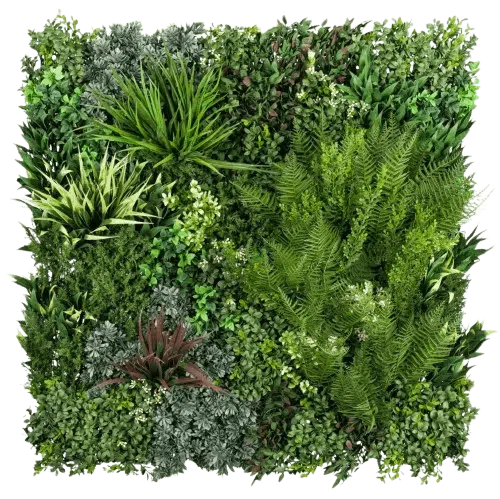 Signature Panel
Our most popular panel with an always-lush look - the ultimate natural backdrop.
Best for: feature walls, living areas, reception spaces
 Essence Panel
A simpler premium-quality mixed foliage panel inspired by our Signature Panels
Best for: fences, gardens, and narrower spaces
 Luxury Flowering Panel
Lush green with a subtle, uplifting bloom-warmth & sophistication.
Best for: terrace & balcony accents, entryways, soft focal points, seating backdrops
 Luxury Boxwood Panel
Perfectly uniform, refined greenery - polished, hedge- like finish.
Best for: formal backdrops, brand walls, privacy screens

Artificial Greenery for Small Spaces: Big Impact in Bathrooms and Home Offices

Green Walls for Cruise Ships: Lush Greenery at Sea, Without the Maintenance Burden

Artificial Green Wall Specification Guide
 English (UK) English (UK)
 English (United States)
 French