
Think back to the last time you sat in a waiting room. For a lot of us the picture is strikingly familiar: magnolia walls, a laminated poster about hand hygiene, a row of fixed chairs and a clock that seems to be running slowly. That isn’t anyone’s fault. Healthcare buildings have to put cleanability, durability and tight budgets first, and decoration tends to come last. But the people sitting in those rooms are often anxious, in pain or waiting for news, and the space around them either adds to that or takes a little of the edge off.
This is where green walls for healthcare are starting to make a real difference. A well designed green wall can change the feel of a reception area, a consulting room or a corridor in a way that paint alone rarely manages, and an artificial system can do it without soil, pollen or a maintenance contract. Many hospitals, GP surgeries, dental practices, private clinics and care homes are already doing exactly this, and the reasons are as practical as they are aesthetic.
It is easy to treat the appearance of a clinical space as a nice extra, but there is a long running body of research suggesting it matters more than we tend to assume.
The most famous example is a study by Roger Ulrich published in Science in 1984. Ulrich compared 46 patients recovering from gallbladder surgery in the same hospital, matched by factors such as age and sex. Those whose windows looked out onto trees had shorter post-operative stays, fewer negative comments in nurses’ notes and took fewer strong painkillers than those who looked onto a brick wall. It was a small study, and the view in question was of real trees, so it would be wrong to claim it proves anything about a green wall specifically. What it did was open up a whole field of research into how the look of a healthcare environment affects the people in it.
More recent work looks at the kind of everyday spaces most patients actually spend time in. A field study by Beukeboom, Langeveld and Tanja-Dijkstra (2012) followed 457 patients in the radiology waiting rooms of a Dutch hospital. Patients were exposed to real plants, to posters of plants or to no nature at all, and both of the nature conditions were linked to lower reported stress. The effects were small but statistically significant, and they were partly explained by patients finding the nature-filled waiting rooms more attractive. It is worth being clear about what this does and does not show. The non-living condition in that study was posters rather than artificial foliage, so it can’t be taken as proof that every artificial wall will reduce stress. What it does suggest is that the benefit isn’t confined to living plants, and that making a clinical space feel more attractive and more natural is a worthwhile aim in its own right, and one reason green walls for healthcare have attracted so much interest from estates teams.
Part of the appeal of green walls for healthcare is simply how much they change a room. A wall of lush, varied foliage gives anxious patients something calm to rest their eyes on, softens the hard, reflective surfaces that dominate many clinical buildings, and signals that the organisation has thought about how it feels to be there.
That matters most in the places where patients have the least else to look at. Many waiting areas, corridors and consulting rooms are internal spaces with little or no natural light or outlook, so there is no tree to look at through the window. Green walls for healthcare can’t replace daylight, but they can bring some of the colour and texture of the outdoors into spaces that would otherwise have none, and artificial foliage keeps looking fresh in a windowless room where living plants would struggle to survive.
It isn’t only patients who benefit. Reception teams, nurses, clinicians and carers spend long shifts in these buildings, and a calmer, more considered environment, which green walls for healthcare can help create, is part of what makes a workplace feel supportive rather than purely functional.
One of the first questions any estates team asks about green walls for healthcare is who will look after them. Healthcare estates and facilities teams are rarely short of things to do. Every hour spent watering, pruning or replacing plants is an hour not spent on something else, and every external contractor visit is a line on a budget that has to be justified.
This is one of the strongest practical arguments for green walls for healthcare in artificial form. A Vistafolia wall has no irrigation system to fail, no plants to replace and no seasonal die back to explain away. In practice it needs little more than an occasional dust or wipe down as part of a normal cleaning routine. That means the wall looks the same in year five as it did on installation day, and it never turns into one more job for a stretched team.
Installation can also be quick and relatively unobtrusive, which matters in a working healthcare setting. At Active Care Group’s Hothfield Rehabilitation Centre in Kent, a bare brick courtyard was transformed with more than 300 square metres of Vistafolia panels in just over two weeks. The client had dismissed natural planting because of the upkeep and ongoing costs involved, and because they wanted an immediate visual impact rather than waiting for plants to establish.
In a healthcare setting, what a plant might release into the air matters as much as how it looks, and this is where living greenery brings real complications.
Soil and compost are natural reservoirs for fungi. A 2025 review of national and international guidance on preventing aspergillosis in hospitals found that avoiding potted plants and soil is among the environmental precautions commonly recommended for the most vulnerable patients, such as those on haematology wards, because Aspergillus moulds are found in soil and organic matter. An earlier study of potted plants growing in a hospital found potentially pathogenic fungi in the soil of the plants it examined. For patients with weakened immune systems, those are not trivial concerns.
Artificial green walls for healthcare settings remove that whole category of risk. The foliage doesn’t produce pollen, doesn’t shed spores and doesn’t need soil, compost or damp growing media, which is a major reason green walls for healthcare settings are often specified in artificial form. Artificial doesn’t mean maintenance free in a clinical sense, though. Like any surface, foliage can collect dust, so it should be built into the regular cleaning schedule, and in clinical areas the infection prevention and control team should always have the final say on what goes where. We would always encourage that conversation to happen early in a project rather than late.
Healthcare buildings are among the most heavily regulated in the country when it comes to fire safety, and rightly so. Many of the people in them can’t easily move themselves, and evacuation depends on a combination of building design and trained staff. In England, the NHS Firecode guidance, including Health Technical Memorandum 05-02, sets out how fire safety should be designed into healthcare premises.
Any finish added to a healthcare building should be considered as part of its overall fire strategy, which is why we encourage specifiers to share test data with their fire safety adviser rather than relying on a supplier’s word alone. It is also why decisions about where a green wall can go, particularly near escape routes, should always be made against the building’s own fire strategy.
This is another area where living and artificial green walls for healthcare differ markedly. A living wall’s fire performance generally holds only while the plants remain alive and well hydrated, and dried out vegetation burns far more readily. Vistafolia panels are independently tested and classified to EN 13501-1:2018 and ASTM E84, with fire retardant properties compounded into the material during manufacture rather than sprayed on the surface where they can wear away over time and repeated cleaning. Combined with a five year warranty and UV stability testing, that gives healthcare estates teams documented evidence to work with.
For private hospitals, clinics, dental practices and wellness providers, the environment is part of the product. Patients paying for care expect an experience that feels considered from the moment they walk through the door, and a tired, institutional waiting room works directly against that impression.
Green walls for healthcare providers in the private sector are increasingly seen as a way to signal quality and care before a patient has even spoken to anyone. This is also the reason to be careful about what you choose. Cheap artificial greenery tends to look exactly like what it is, with flat colour, repeated patterns and foliage that fades or sags within a couple of years. In a setting where first impressions carry real weight, a poor quality wall can do more harm than leaving the wall bare.
A good example is the Charlbury Dental Practice in Oxfordshire. The practice wanted an atmosphere that put patients at ease without creating a maintenance burden, and used Vistafolia panels with signage in front of the wall to turn the waiting area into a calm, welcoming space that also works as a branding opportunity. The client could view our display in Frimley and talk through the options with our team before committing.
Reception and waiting areas are the obvious starting point, since they are where patients spend the most time feeling anxious and have the least to occupy them. Corridors and circulation spaces are another strong candidate, because a long, blank wall can be transformed into a feature that makes the journey through the building feel less clinical.
Beyond those, green walls for healthcare settings work well in consulting and treatment rooms where a calming backdrop helps, in staff rooms and break areas, in care home lounges and communal spaces, and in outdoor courtyards and gardens where a bare wall or fence can be softened and given privacy. Because the system needs no light and no water, it can go in places where living planting would never survive.
The same thinking applies well beyond the UK. At Sentara Healthcare’s facility in Virginia Beach, the client wanted something eye-catching on an outer wall for patients to enjoy. Biophilic design mattered to them, but a living wall was ruled out because of concerns about maintenance, ongoing cost and water usage, so green wall panels were alternated with metal panels to create a more varied display. In Richmond, Virginia, Legacy at Imperial Village, a residential community for seniors, used a green wall to give its lobby more character for residents, staff and visitors, while keeping to a budget-friendly approach. The providers and the countries differ, but the pattern is the same: green walls for healthcare chosen because they deliver the look without the upkeep.
Vistafolia panels are hand-designed in the UK by an award winning horticulturist and hand assembled at our factories, with around 65 to 72 individual plants in each panel so that the finished wall avoids the flat, repetitive look that gives lower quality products away. Every system is independently tested for fire performance and UV stability and backed by a five year warranty, and our portfolio includes healthcare, care home and dental installations that can be reviewed rather than taken on trust.
Whether you are specifying green walls for healthcare for the first time or refreshing an existing space, get in touch with our team. We can talk through your space, share relevant project examples, and help you put together a specification that works for patients, staff and your estates and infection control teams alike.
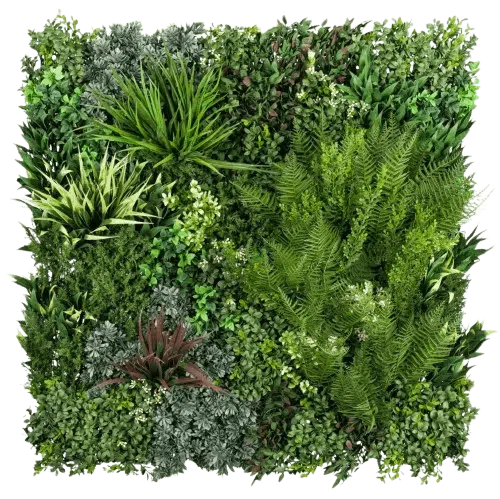 Signature Panel
Our most popular panel with an always-lush look - the ultimate natural backdrop.
Best for: feature walls, living areas, reception spaces
 Essence Panel
A simpler premium-quality mixed foliage panel inspired by our Signature Panels
Best for: fences, gardens, and narrower spaces
 Luxury Flowering Panel
Lush green with a subtle, uplifting bloom-warmth & sophistication.
Best for: terrace & balcony accents, entryways, soft focal points, seating backdrops
 Luxury Boxwood Panel
Perfectly uniform, refined greenery - polished, hedge- like finish.
Best for: formal backdrops, brand walls, privacy screens

Artificial Greenery for Small Spaces: Big Impact in Bathrooms and Home Offices

Green Walls for Cruise Ships: Lush Greenery at Sea, Without the Maintenance Burden

Artificial Green Wall Specification Guide
 English (UK) English (UK)
 English (United States)
 French