
Architects have more choice than ever when it comes to incorporating greenery into commercial developments. Green walls can transform an otherwise hard architectural environment, introduce colour and texture, soften large expanses of concrete or brick and create spaces that feel more welcoming to the people who use them. Often they are for aesthetic reasons, but they can also be for environmental reasons.
For many projects, the obvious starting point is a living wall. After all, if the brief calls for greenery, why not use the real thing?
The answer is that living walls can be fantastic when the conditions are right and the client is prepared for the long-term commitment they require. But specifying a living wall also means specifying an ongoing horticultural system, with all the risks, maintenance and environmental requirements that come with it. They may also not be as ‘green’ as they appear.
For architects working on major commercial projects, those considerations matter. A feature that looks spectacular when the building opens but struggles to perform five years later can create significant problems for the client, facilities team and architect alike.
This is where artificial commercial green walls can offer a compelling alternative.
Vistafolia has developed a premium artificial green wall system specifically designed to deliver the visual impact of sophisticated planting without many of the long-term uncertainties associated with living systems. For architects, that can mean greater flexibility during the design process, fewer ongoing demands for the building operator and considerably more confidence that the finished installation will continue to look the way it was intended to look.
So, why should architects consider specifying Vistafolia rather than a living wall?
Here are five reasons.
1. Commercial Green Walls Need to Be Designed for Long-Term Reliability
Perhaps the biggest consideration when specifying any feature within a commercial building is what happens after the photographs have been taken and the project has been handed over.
Living walls are living systems. That is their appeal, but it is also their inherent vulnerability.
Plants need the right levels of light, water, nutrients, temperature and humidity. Irrigation systems need to operate correctly. Maintenance needs to be carried out properly and consistently. Plants that fail need to be identified and replaced. If the environment changes, the planting may respond accordingly. How often do you see large commercial green walls that are looking past their best?
There are countless reasons why a living wall can deteriorate.
An irrigation system can fail. A maintenance programme can be neglected. A particular plant species may not thrive in its chosen location. Access may become difficult. Changes to the surrounding environment may affect the conditions in which the plants are growing.
None of this means that living walls are inherently bad products. It means they need to be treated as living ecosystems rather than static architectural features.
For an architect specifying commercial green walls, that distinction is important.
The question is not simply whether the wall will look good when it is installed. It is whether it is likely to continue looking good years down the line.
Vistafolia approaches the problem differently. Our systems are designed to be robust and to provide a consistent appearance without relying on living plants remaining healthy in a particular environment. They have been developed and tested for long-term performance, including exposure to demanding outdoor conditions.
That gives architects a different proposition: greenery designed to remain consistent rather than greenery that needs to continually grow and survive.
Our track record provides further reassurance. Vistafolia installations have been delivered across a wide range of environments, including demanding commercial and outdoor applications, demonstrating that premium artificial greenery can be a genuinely long-term architectural solution.
When specifying commercial green walls, longevity should therefore be considered from the beginning rather than treated as an afterthought.
2. Commercial Green Walls Should Not Create an Open-Ended Maintenance Commitment
The second major consideration is cost.
The initial installation price of a living wall is only part of the equation. Unlike conventional decorative finishes, a living wall requires ongoing care throughout its life.
That can include irrigation, feeding, pruning, plant replacement, pest control, cleaning and regular inspections. Depending on the system and location, specialist maintenance personnel may be required to keep the installation healthy.
Over a period of five or ten years, those costs can become substantial.
For a commercial building, this creates another consideration for the architect. The client is not simply buying a feature. They are committing to an ongoing maintenance programme that may continue for as long as the wall exists.
That commitment may be perfectly acceptable for some clients. For others, it may become an unwanted operational expense.
Vistafolia offers a fundamentally different proposition.
Once installed, our artificial green walls require very little ongoing attention. Indoor installations generally need little more than occasional dusting, while outdoor installations can be lightly hosed down when necessary.
There is no irrigation system to maintain, no soil to manage, no fertiliser programme and no plants that need to be continually monitored for signs of distress.
For architects, this can be particularly valuable when commercial green walls are being specified in areas where access is difficult or expensive.
A wall several metres above ground level, a feature within a large atrium or greenery installed on a roof section may look spectacular, but regular access for horticultural maintenance can be a significant logistical issue.
With an artificial system, that ongoing burden is dramatically reduced.
The result is not simply a lower-maintenance green wall. It is a more predictable long-term asset for the building.
3. Vistafolia Has Experience at the Scale Commercial Projects Demand
Architects specifying commercial green walls are often working within complex projects involving multiple stakeholders, demanding deadlines and considerable expectations.
The product therefore needs to be supported by a company that understands commercial projects, not simply one that manufactures artificial foliage.
Vistafolia has developed a strong reputation within the commercial sector through work with high-profile clients and major projects across a variety of industries.
Our portfolio includes projects for global retail chains, major sports venues and luxury hotel groups, alongside a wide range of commercial, hospitality and residential developments.
This experience matters.
Working on a major commercial project requires considerably more than supplying boxes of artificial plants. There may be architects, interior designers, contractors, project managers, facilities teams and client representatives involved, all of whom need confidence that the greenery can be delivered to the required specification.
There are also practical considerations around access, fixing methods, fire performance, project scheduling and installation.
Our experience means that we understand these requirements and can work alongside project teams to find appropriate solutions.
For an architect, that provides an important degree of reassurance when specifying commercial green walls.
Rather than simply specifying a product, you are specifying a system backed by a company with experience delivering it in real-world commercial environments.
That experience is particularly valuable when a project involves an unusual application or a challenging installation location. The ability to look at a problem and find a workable solution can be just as important as the appearance of the foliage itself.
4. Artificial Commercial Green Walls Go Where Living Walls Cannot
One of the biggest advantages of artificial greenery is its flexibility.
Living plants are dependent on their environment. They need sufficient light, suitable temperatures, appropriate humidity and access to water and nutrients. If those conditions are not available, the choice of plant species becomes increasingly restricted or specialist systems may need to be introduced to compensate.
Artificial greenery does not have those biological requirements.
That makes Vistafolia suitable for a much wider range of applications.
Commercial green walls can be incorporated into areas that would be challenging for living plants, including darker interiors, difficult-to-access spaces, roof sections, lightwells and other architectural features where regular horticultural maintenance would be impractical.
This can fundamentally change the design conversation.
Instead of asking whether the building provides the right conditions for a particular plant palette, the architect can start with the desired aesthetic and then explore how the artificial green wall can be incorporated into the architecture.
That freedom is particularly valuable on complex commercial projects.
Consider a roof terrace, for example. A living installation may require irrigation, drainage, suitable growing media and regular access for maintenance. An artificial system can provide the visual effect without introducing the same horticultural infrastructure.
The same principle applies to a large atrium or feature wall that is difficult to reach. The higher the wall and the more challenging the access, the more significant the practical advantages of a low-maintenance system become.
Vistafolia’s versatility also extends to the installation itself. Our systems can be fixed to a wide range of substrates, with bespoke solutions available for unusual surfaces and structures.
For architects, this means commercial green walls can become part of the design rather than being constrained by the limitations of conventional planting.
5. The UK’s Changing Climate Makes Water and Plant Resilience Increasingly Important
The final reason is perhaps the one that will become increasingly important over the coming years.
The UK’s climate is changing. Recent summers have brought periods of intense heat and prolonged dry weather, placing additional pressure on water supplies and on plants themselves. The traditional assumption that the British climate will always provide mild, wet conditions is becoming increasingly difficult to maintain.
For living walls, extreme weather can create additional challenges. Periods of drought increase irrigation requirements. Plants that are poorly suited to heat can struggle. Maintaining healthy planting during prolonged periods of high temperatures can require considerably more water and horticultural intervention.
This creates an interesting contradiction.
One of the reasons we introduce greenery into buildings is to create a more sustainable and pleasant environment. Yet maintaining a living installation in increasingly challenging weather conditions can require significant resources.
Artificial greenery does not need water to survive.
For architects considering commercial green walls, that means the system can provide year-round greenery without creating an ongoing demand for irrigation.
Of course, artificial greenery is not a replacement for every living planting scheme. Biodiversity, habitat creation and the ecological benefits of genuine planting remain important considerations.
But where the primary objective is visual impact, branding, placemaking or architectural enhancement, a high-quality artificial system can provide an extremely practical alternative.
Why Architects Can Specify Vistafolia Commercial Green Walls
The five reasons above explain why architects might choose artificial greenery over living planting. But there is another important question.
Why choose Vistafolia?
Specifying commercial green walls requires confidence that the product will meet the practical requirements of the project as well as the aesthetic brief. Vistafolia has been designed with this in mind. Our artificial greenery is created by hand in the UK, with the foliage designed by an award-winning horticulturalist and carefully selected colours and textures developed to replicate the variation found in nature.
The result is a product that is intended to look convincing not only from a distance, but close up.
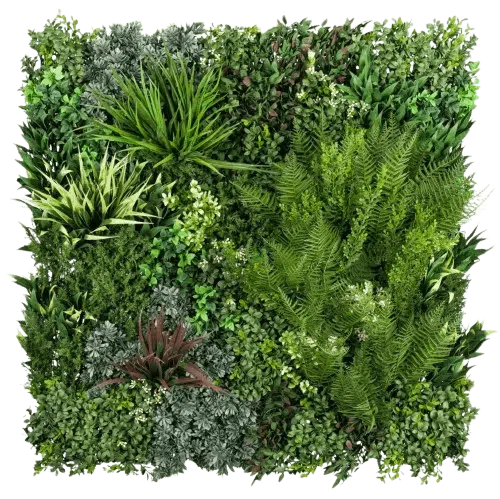
Our Signature green wall system is also different from many cheaper artificial walls. Rather than simply attaching foliage to a basic plastic mat, our panels are hand assembled using individual plants and backed with a stainless steel grid for additional strength and longevity. Each panel contains between 65 and 72 plants, contributing to a dense, layered appearance.
The multi-panel system is designed to reduce obvious repetition between adjacent panels, helping larger commercial green walls maintain a natural appearance across their entire surface.
There are also practical considerations that matter greatly within commercial buildings.
Vistafolia products have been independently tested to recognised international standards, including fire performance and UV stability. These characteristics are particularly important when specifying commercial green walls because building regulations and project requirements can place strict demands on decorative materials.
Our five-year warranty provides further reassurance, while our portfolio of completed projects provides social proof that the system has already been successfully used in demanding environments.
And because our design and production operation is based in the UK, architects and project teams can work directly with a specialist team that understands the requirements of the market.
Commercial Green Walls: A Specification That Can Reduce Risk
Ultimately, the decision between a living and artificial green wall should not be based purely on which looks better.
Both can create beautiful spaces, and living walls have a legitimate role to play in architecture and landscape design.
The more important question is which solution is most appropriate for the building, the environment and the client’s long-term requirements.
For many commercial projects, the answer will be an artificial system.
Vistafolia commercial green walls can offer the visual impact of dense, realistic planting without the irrigation, horticultural maintenance and environmental requirements of a living wall. They can be specified for challenging locations, provide a consistent appearance throughout the year and offer the reassurance of independent testing, a five-year warranty and a proven commercial track record.
For architects, that combination can make the specification process considerably more straightforward.
You can design the greenery into the project knowing that it is not dependent on a complex living ecosystem continuing to function perfectly for years after completion.
And perhaps most importantly, you can specify a system that has already been used successfully by major organisations across retail, hospitality, sport and other commercial environments.
If you’re currently working on a commercial project and considering commercial green walls, we’d love to discuss the possibilities with you. From initial concept and design through to specification and installation, the Vistafolia team can help develop a solution that fits both the architectural vision and the practical demands of the building.
Contact Vistafolia today to discuss your project and discover how premium artificial greenery can become a reliable, high-impact part of your next commercial development.


 English (UK)
 English (United States)
 French